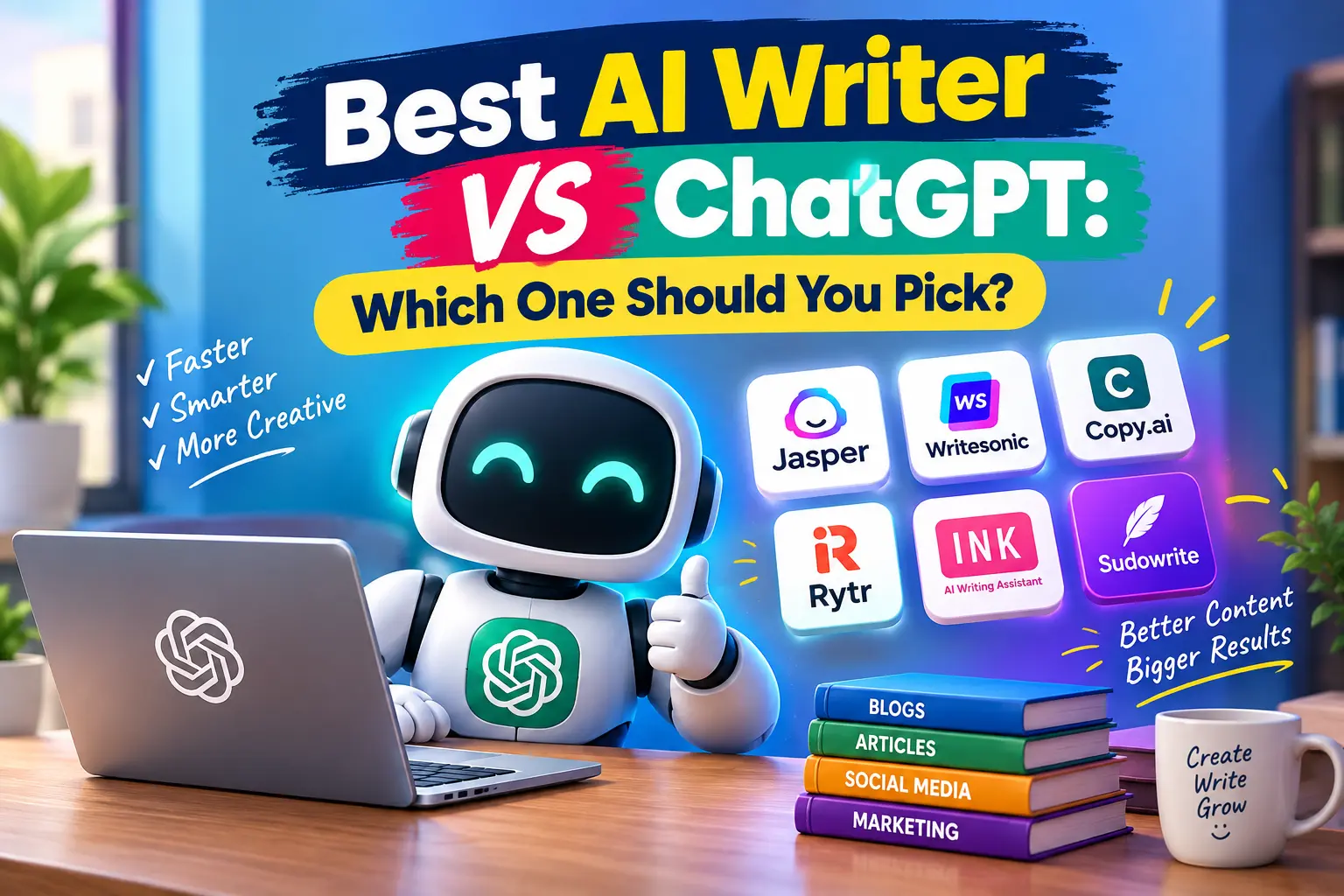

Meta description: Looking for the best AI writer for marketing? Compare ChatGPT, Claude, Jasper, Copy.ai, Writesonic, Anyword, and more, with real pricing and honest pros and cons.
A small business owner sits down at 9 p.m. She has ten product pages to write. Her coffee is cold. Her deadline is tomorrow morning. This is where an AI writer for marketing earns its place. The right tool turns a ten-hour job into a two-hour job. The wrong tool wastes your evening and your money.
This guide compares nine AI writing tools built for marketing work. Every price and feature here comes from real research done in 2026. No tool gets a free pass. Each pick includes what it does well and where it falls short.
By the end, you will know exactly which AI writer for marketing fits your budget, your workflow, and your goals.
What Makes an AI Writer Good for Marketing
Marketing writing is different from general writing. A blog post needs SEO structure. An ad needs a hook in five words. An email needs a subject line that gets opened. A generic AI chatbot can write a paragraph. A true marketing writer needs more than that.
Look for these things before you pay for any tool:
- Brand voice memory. The tool should sound like your brand every time, not a new voice each session.
- SEO support. Keyword research, content scoring, or search intent guidance built into the workflow.
- Multiple formats. Blog posts, ads, emails, and product copy from one platform.
- Editing controls. Tone sliders, length settings, and rewrite options.
- Fair pricing. Word limits and seat costs that match your actual output.
Ten tools claim to check every box. Few actually do. Here is how the top options compare.
ChatGPT: The Free All-Rounder
ChatGPT remains the starting point for most marketers in 2026. Ninety percent of content marketers now use AI tools in their work, and ChatGPT is often the first one they try. The free tier runs on GPT-5.2 Instant and handles blog drafts, ad copy, product descriptions, and social captions without a subscription.
The paid Plus plan costs $20 a month and unlocks a deeper thinking mode plus Canvas, a side-panel editor built for targeted rewrites. Canvas lets you highlight a paragraph and ask for a specific change, instead of regenerating the whole draft.
Strengths:
- Free tier is genuinely usable, not a stripped-down demo.
- Handles almost every content format a marketer needs.
- Fast output, useful for high-volume content calendars.
Limitations:
- No brand voice enforcement across sessions.
- No built-in SEO scoring or keyword research.
- No team analytics for agencies managing multiple clients.
ChatGPT works best as your default writer. Pair it with a specialized tool once your needs get more specific.
Claude: The Choice for Natural-Sounding Prose
Claude built its reputation on prose quality. Marketers who care about tone, especially for long-form blog content, email newsletters, and brand storytelling, tend to prefer Claude's output over other models. Reviewers testing the field in 2026 consistently rank Claude highest for writing that reads like a human wrote it, not a machine.
Claude offers a free tier with usage limits, a Pro plan at $20 a month, and higher-volume Max plans for heavy users. Business and Team plans start around $25 per seat per month.
Strengths:
- Strongest raw writing quality among general-purpose models.
- Artifacts feature shows a live preview of your document as it builds.
- Handles long documents with a consistent voice from start to finish.
Limitations:
- No dedicated marketing templates out of the box.
- No native SEO scoring tool.
- Best results require some prompt skill from the user.
Pick Claude when the words themselves carry the weight, cornerstone blog posts, brand narratives, or long email sequences where tone cannot slip.
Jasper: Best for Brand Voice Control
Jasper built its whole platform around one problem: AI tools sound generic. Feed Jasper your existing content, and it studies your tone, then applies that voice across every new piece it writes. This single feature explains why review sites keep naming Jasper the top overall pick for marketing teams.
Jasper also routes requests across GPT, Claude, and Gemini behind the scenes, picking whichever model suits the task. You never see the switch happen.
Pricing sits at $59 per seat per month on most current plans, though some reviewers list an entry point closer to $49.
Strengths:
- Brand Voice feature is the best in its category.
- Multi-model routing means you get strong output without picking a model yourself.
- Deep template library for ads, emails, and landing pages.
Limitations:
- Setup takes real time. Voices, campaigns, and templates all need configuration first.
- Pricing sits higher than most competitors.
- Overkill for a solo blogger who just needs occasional drafts.
Jasper fits agencies and in-house teams juggling several brand voices at once.
Copy.ai: Best Free Plan for Marketing Teams
Copy.ai started as a copywriting tool and grew into something closer to a full go-to-market platform. That shift changed its pricing structure, but the free plan remains one of the strongest in the category, offering 2,000 words a month with access to 90-plus marketing templates.
Paid plans start near $36 a month for the Pro tier, unlocking unlimited words and Workflow automation. Higher enterprise tiers climb past $1,000 a month, aimed at large sales organizations rather than solo marketers.
Strengths:
- Best free tier for testing AI copywriting without a credit card.
- Strong template range for emails, ads, and sales copy.
- Workflow automation connects multiple content steps into one process.
Limitations:
- No built-in SEO tooling. It writes text but does not check keyword coverage.
- The jump from the entry plan to enterprise pricing is steep.
- Leans more toward sales enablement than pure content marketing now.
Copy.ai works well for small teams that want breadth: ads, emails, and social copy from a single home base.
Writesonic: Best for SEO-Focused Content
Writesonic built its 2026 identity around two goals: ranking in traditional search and showing up inside AI answers, a category now called Generative Engine Optimization, or GEO. Its Article Writer 6.0 produces structured, long-form drafts up to 1,500 words in under a minute, and it holds a coherent thread across the full piece.
Pricing ranges depending on the source, with entry points reported between $16 and $49 a month, plus higher team plans around $79 a month that add GEO tracking across AI search engines.
Strengths:
- Article Writer stays coherent across 1,500 to 2,000 words, rare at this price point.
- Chatsonic adds live web browsing for current data inside your draft.
- Native Surfer SEO integration for on-page optimization.
Limitations:
- Team collaboration features feel basic compared to dedicated project tools.
- Less useful for short-form ad copy or sales sequences.
- Pricing varies by source, so check the current plan details before buying.
Choose Writesonic when your main job is publishing blog content that needs to rank.
Anyword: Best for Ad Copy That Converts
Anyword takes a different approach. Instead of just generating copy, it predicts how well that copy will perform before you spend a dollar on it. The tool scores each variant against your audience data, so you can test ad headlines and product descriptions with actual performance signals attached.
Pricing starts around $39 a month on an annual plan.
Strengths:
- Predictive performance scoring removes guesswork from A/B testing.
- Strong fit for paid ad copy, landing pages, and email subject lines.
- Supports proven copywriting frameworks like AIDA and PAS.
Limitations:
- Less suited to long-form blog content than the tools above.
- Scoring accuracy depends on the quality of data you connect.
- Narrower focus than an all-in-one platform like Jasper or Copy.ai.
Anyword earns its subscription fastest for teams running paid campaigns with real ad spend on the line.
Surfer AI and Frase: Best for SEO Research
Two tools deserve a joint mention here, since marketers often use them side by side with a general writer like ChatGPT or Claude.
Surfer AI aligns your draft with what already ranks in search results. It scores your content in real time as you write, checking keyword density, structure, and topic coverage against top-ranking pages.
Frase focuses earlier in the process. It builds content briefs from live search data, so your team knows what to cover before a single word gets written. Reviewers note that Frase saves significant research time but produces weaker draft quality than dedicated writing tools.
Strengths:
- Both tools reduce guesswork around what search engines want.
- Frase briefs keep freelance writers or teams aligned on scope.
- Surfer's live scoring catches gaps before you publish.
Limitations:
- Neither tool writes strong long-form copy on its own.
- Best used as a research layer paired with a separate writer.
- Adds a second subscription on top of your main AI writer.
Add one of these tools once your content calendar depends on organic search traffic.
Rytr: Best Budget Pick
Not every business needs an enterprise platform. Rytr offers a genuinely low-cost option, with an unlimited plan reported around $29 a month and an even lower entry tier near $7.50 to $9 a month on annual billing.
Strengths:
- Lowest price point among tools with a real unlimited plan.
- Covers common formats: emails, ads, product descriptions, blog intros.
- Simple interface with a short learning curve.
Limitations:
- Output quality trails behind Jasper, Claude, or ChatGPT on complex pieces.
- Character limits apply on the free tier.
- Fewer advanced features for teams managing brand voice across seats.
Rytr suits solo entrepreneurs and small shops testing AI writing for the first time without a big budget commitment.
Human Editing Still Matters
Here is a number worth sitting with. Fully human-written content generates over five times more organic traffic than unedited AI content, based on a study across 744 articles. That gap sounds harsh for anyone leaning on AI tools.
Now the other side of that same study: AI content reviewed and improved by a human performs 127% better than raw, unedited AI output. Once brand voice training gets set up properly, hybrid content, AI draft plus human polish, lands within 5 to 10% of fully human results.
The lesson here is simple. The tool you pick matters less than what you do after the draft appears. A budget tool paired with careful editing can beat an expensive tool left on autopilot. Read every draft. Fix awkward phrasing. Check every fact. Add a detail only a real person would know. That last step is often what separates content readers trust from content they scroll past.
How to Pick the Right Tool for Your Team
Most successful marketing teams do not rely on one single tool. They combine two or three: a general-purpose writer for daily drafts, a specialized tool for their main use case, and an editing tool to polish the final copy.
Use this quick breakdown to match a tool to your situation:
- Solo blogger on a budget: Start with ChatGPT's free tier or Rytr's low-cost plan.
- Agency managing several brand voices: Jasper's Brand Voice feature justifies the higher price.
- SEO-first content team: Writesonic or Surfer AI, paired with Frase for briefs.
- Sales and marketing hybrid team: Copy.ai's workflow automation and CRM connections.
- Paid ad team testing variants: Anyword's predictive scoring.
- Anyone prioritizing prose quality: Claude, especially for long-form brand storytelling.
Test the free tier first wherever one exists. Most of these platforms let you generate real output before you commit a card number. Run the same prompt through two or three tools. Compare the drafts side by side. The differences show up fast.
The Bottom Line
An AI writer for marketing will not replace your judgment. It replaces the blank page. Ninety percent of content marketers already build these tools into daily work, and the teams pulling ahead are not the ones generating the most words. They are the ones editing carefully, matching the tool to the task, and keeping a real person in the loop before anything goes live.
Start with a free plan today. Write one real piece of content with it. Then decide if a paid upgrade earns its place in your budget.